The DisruptivX journey through computing history
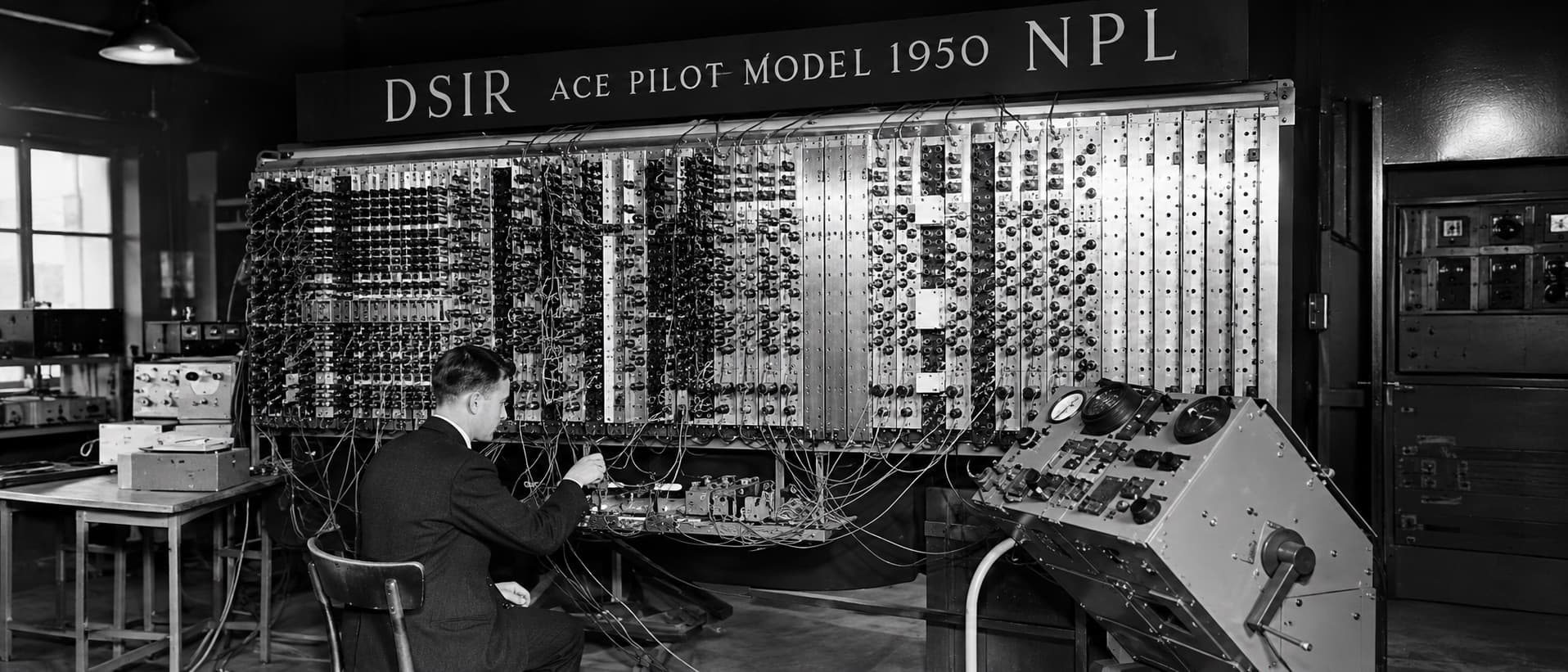
A walk through time
We help leaders navigate every turn. Take the journey with us.
The Idea of a Machine
Turing imagines a machine that can compute anything that can be computed.
Turing's universal machine started as a proof on paper. By 1945 it had broken the Enigma cipher at Bletchley Park and shortened the war by an estimated two years. The world learned its first lesson in computing: an idea, applied with intent, could outperform the largest organisations of its time. Computing began as a strategic asset, and has been one ever since.
Rooms Full of Logic
ENIAC, EDVAC, and the von Neumann architecture establish the modern computer.
The first commercial machines were the size of buildings: eighteen thousand vacuum tubes, a hundred and fifty kilowatts of draw. They ran the United States census, calculated artillery tables, and on election night in 1952 predicted Eisenhower's win on live television. Within a decade, every Fortune 500 company had begun the same conversation. How do we run our business on one of these?
The Transistor Revolution
Bell Labs, the integrated circuit, and the System/360.
A piece of silicon a few millimetres across replaced a glass tube the size of a fist. IBM's System/360 became the largest commercial product launch in history. Airline reservations, bank ledgers and insurance actuaries were rebuilt around it. By 1969 the same architecture flew Apollo to the moon. Software, not hardware, became the lasting asset; the strategic question moved from 'should we buy a computer' to 'what can we make it do.'
Computing Becomes Personal
The microprocessor, the GUI, the desktop.
Intel's 4004 put a CPU on a single chip. Apple, IBM and Compaq put one on every desk. The arrival of VisiCalc in 1979 turned the personal computer from a hobbyist machine into a business tool, and any analyst with a spreadsheet could model a deal that previously took a department. Productivity per knowledge worker rose by orders of magnitude. The advantage shifted from owning the machine to knowing what to do with it.
Everything Becomes a Network
The web, search, and the protocol that ate the world.
A research project became the largest fabric humans have ever built. Email replaced the fax. Amazon and eBay reinvented retail. Google restructured how the world found information. Whole industries, from travel agents to classifieds to encyclopaedias, disappeared in a decade. The companies that arrived early on the internet didn't just win their category; they redefined it.
The Computer in Your Pocket
The smartphone collapses distance, time, and category.
Three billion people inherited the equivalent of a 1990s supercomputer in their pocket. The app became the unit of business. Uber rebuilt taxi networks in two years; Airbnb rebuilt hospitality in three. WhatsApp replaced text messaging across emerging markets, and M-Pesa replaced bank accounts across East Africa. The cost of reaching a customer dropped to a download; the cost of being slow rose.
Compute Without Walls
Hyperscale, elastic infrastructure, and the data abundance.
Capital expenditure became an API call. A startup could spin up an entire data centre's worth of compute in an afternoon. Netflix, Spotify and Uber were built on someone else's hardware. Three providers, AWS, Azure and Google, became the substrate of the digital economy. Data, once a by-product, became the strategic asset. The enterprise stopped owning servers and started owning judgement.
The AI Era Arrives
Transformers, foundation models, and the agentic shift.
A paper called Attention Is All You Need quietly rewrote the discipline in 2017. Eight years later, language models write code, draft contracts, design products and run customer service. For the first time in computing history, capability is outrunning headcount. Software has stopped being instructions and started being intent. The enterprise that can translate that capability into operating leverage will own the decade; the one that can't, won't.
What Comes Next
Quantum, neuromorphic, and the limits we haven't met yet.
Quantum supremacy demonstrated. Quantum advantage in cryptography, drug discovery and optimisation already in early deployment. Neuromorphic silicon in early production. The next decade is not an extension of this one; it is a different physics of computation. The leaders investing now are the ones who will own the twenty-thirties. The rest will be watching it happen to them.
We live this.
Ninety years of computing taught us one thing: technology only matters when it moves the business. We help leaders make sure theirs does.
Four practices, one thesis.
Technology has to translate into the outcomes that matter: growth, cost, risk, and the assets you have built. See the practices we use to make sure it does.
See how we work→Tell us what you're building.
We work with a small number of leaders at any one time. If the work you are describing is real, we would like to hear about it.
Talk to us→